RBI’s FY26 GDP Forecast — Background, Context & Key Reasons

Lorem ipsum dolor sit amet, consectetur adipiscing elit. Ut elit tellus, luctus nec ullamcorper

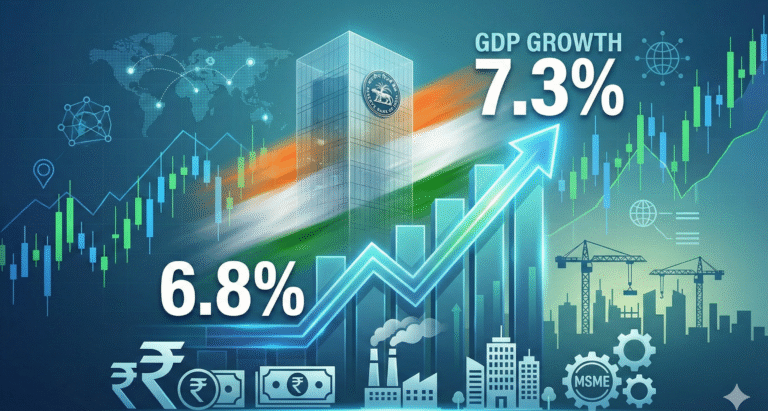
India’s economy is entering a stronger growth phase for FY26 (2025–26). The Reserve Bank of India (RBI) has recently revised its GDP growth forecast from 6.8% to 7.3%, indicating that the Indian economy is performing better than expected.

In this part, we will understand:

  • What a GDP forecast means
  • Why RBI upgraded the forecast
  • Which economic indicators have improved
  • The current state of the Indian economy

mattis, pulvinar dapibus leo.

What Is a GDP Forecast?

A GDP forecast is an estimate of how fast a country’s economy will grow in the upcoming financial year.

  • A higher forecast → signals strong economic fundamentals
  • A lower forecast → indicates slowdown risk

RBI’s forecasts are highly influential for businesses, investors, banks, policymakers, and the stock market, as they shape future economic expectations.

Why Did RBI Raise the Forecast from 6.8% to 7.3%?

According to the RBI, several major growth pillars of the Indian economy are performing better than earlier estimates. The most important drivers are

(A) Strong Recovery in the Manufacturing Sector

  • Purchasing Managers’ Index (PMI) remains in the expansion zone
  • Domestic and export demand are improving
  • Capacity utilisation in factories has increased sharply

A strong manufacturing revival is a direct sign of real economic strength.

(B) Robust Growth in the Services Sector

India’s services sector continues to act as the backbone of the economy.
Expected strong growth in:

  • IT & digital services
  • Banking and financial services
  • Travel, tourism, hospitality
  • Retail and e-commerce

The services sector significantly contributes to overall GDP acceleration.

(C) Government’s Heavy Capital Expenditure Push

The government has announced record-high capital expenditure for FY24–FY26.
Key areas include:

  • Highways and metro projects
  • Railway modernisation
  • Ports, airports, and logistics infrastructure

Capex has a multiplier effect: more jobs + more industrial demand.

(D) Gradual but Steady Revival in Rural Demand

  • Stable agricultural production
  • Supportive monsoon conditions
  • Improving FMCG and consumption trends in rural areas

Rural recovery strengthens overall domestic demand.

Current State of the Indian Economy 2025–26

RBI’s analysis highlights four major macro indicators reflecting India’s economic strength:

(A) Inflation Under Control

  • CPI inflation has eased
  • Food inflation is stabilising
  • Policy environment has become more predictable

Low inflation improves purchasing power and business confidence.

(B) Banking Sector at Its Best Health in Years

  • NPAs at multi-year lows
  • Strong credit growth
  • Rising loan demand from MSMEs

A healthy banking sector accelerates overall growth.

(C) Stable Consumption Demand

  • Strong urban consumption
  • Record-high automobile sales
  • Steady housing and real-estate demand

Since consumption contributes nearly 60% to GDP, stability here is crucial.

(D) India’s Strong Global Position

  • Despite global slowdown, India remains the fastest-growing major economy
  • FDI inflows stable
  • Rapid expansion of the digital economy

This resilience is part of why RBI has turned more optimistic.

How the 7.3% GDP Forecast Will Impact Key Sectors of the Indian Economy

With the RBI revising India’s FY26 GDP growth projection to 7.3%, the economic outlook turns more optimistic for businesses, investors, industries, and consumers. This upgraded forecast is expected to influence several major sectors of the economy in meaningful ways.

Impact on the MSME Sector

Micro, Small, and Medium Enterprises (MSMEs) are among the biggest beneficiaries of accelerating economic growth.

Key impacts

  • Higher demand for manufactured goods and services
  • Increased credit availability from banks due to better economic confidence
  • More government support and targeted schemes
  • Growth in retail, logistics, textile, and small manufacturing units

A stronger GDP environment improves cash flow and encourages MSMEs to expand capacity and invest in technology.

Impact on Real Estate & Infrastructure

A 7.3% growth outlook directly boosts India’s real estate and infrastructure sectors.

For real estate

  • Higher housing demand in urban and semi-urban regions
  • Increased construction activities
  • Rising commercial property investments

For infrastructure

  • Government projects are likely to accelerate
  • More private sector participation in roads, metros, airports
  • Improved investor sentiment for long-term assets

Since infrastructure spending has a multiplier effect, this sector will be a major engine of growth.

Impact on the Stock Market & Investors

Stock markets typically respond positively to strong GDP forecasts.

Expected outcomes

  • Improved market sentiment
  • Increased foreign portfolio investment (FPI)
  • Higher valuations in banking, FMCG, auto, and capital goods sectors
  • More stability for long-term equity investors

A better growth outlook also reduces the risk of market volatility.

Impact on Banking & Financial Services

The financial sector is a major beneficiary of rising GDP forecasts.

Key impacts

  • Higher demand for personal, housing, auto, and MSME loans
  • Strong credit growth for banks
  • Stable or improving asset quality (low NPAs)
  • Increased financial inclusion and digital payments

With economic activity expanding, banks and NBFCs will likely see stronger bottom-line growth.

Impact on the Manufacturing Sector

Manufacturing will see a significant positive push due to:

  • Higher domestic consumption
  • Rising export opportunities
  • Increase in production capacity
  • Government support through PLI (Production-Linked Incentive) schemes

Sectors like automobiles, electronics, chemicals, and machinery are expected to benefit directly.

Impact on the Services Sector

Services contribute more than 50% to India’s GDP. A higher forecast signals strong momentum in:

  • IT and technology services
  • BFSI (Banking, Financial Services, Insurance)
  • Tourism, aviation, and hospitality
  • Retail and e-commerce
  • Professional services and consulting

A growing economy boosts demand across all service categories.

Impact on Consumer Spending

Higher economic growth generally leads to:

  • Increased income levels
  • Higher purchasing power
  • More spending on automobiles, real estate, electronics, and travel

Strong consumer sentiment strengthens the overall demand cycle.

Impact on Foreign Investors (FDI & FPI)

A rising GDP forecast positions India as a stable and attractive investment destination.

Expected impacts

  • More long-term foreign direct investment (FDI)
  • Improved capital market inflows
  • Global companies expanding operations in India
  • Increased interest in manufacturing, tech, and renewable energy sectors

India’s strong macroeconomic stability makes it competitive compared to other major global economies.

Key Risks, Challenges & RBI’s Future Economic Outlook

Even though the Reserve Bank of India’s upward revision of the FY26 GDP forecast to 7.3% signals strong economic momentum, the path ahead is not entirely free from challenges. Several domestic and global risk factors could influence how close India comes to achieving this growth estimate. In this final section, we break down the major risks, headwinds, and RBI’s forward-looking economic stance to understand the broader macroeconomic picture.

Major Risks & Challenges to FY26 Growth

Global Economic Slowdown Threat

A sluggish performance in major economies like the US, Eurozone, and China could reduce India’s export demand.

  • Slower global trade recovery
  • Rising geopolitical tensions
  • Volatility in currency markets
    These external shocks can affect sectors such as IT services, textiles, and manufacturing exports.


Crude Oil Price Volatility

India imports more than 85% of its crude oil, making the economy highly sensitive to oil prices.
If crude oil remains above the $90–$100 range:

  • Inflation pressure increases
  • Trade deficit widens
  • Government subsidy burden rises

This risk could push inflation higher than RBI’s comfort zone, forcing tighter monetary policy.

Food Inflation & Monsoon Uncertainty

Agriculture still contributes significantly to rural spending. Weak rainfall or climate-related disruptions may:

  • Reduce crop output
  • Push food inflation up
  • Weaken rural consumption

Since rural demand drives FMCG, two-wheelers, and agriculture-linked sectors, this remains a critical risk.

Fiscal Deficit & Government Borrowing Pressure

Although the government has committed to fiscal consolidation:

  • High capital expenditure
  • Welfare commitments
  • Subsidy requirements

…can limit fiscal space. High government borrowing also impacts liquidity and interest rates in the bond market.

Global Financial Market Volatility

Any unexpected tightening by the US Federal Reserve or global risk aversion can:

  • Trigger FPI (Foreign Portfolio Investor) outflows
  • Create currency pressure
  • Affect stock market stability

Stable capital flows remain essential for sustaining growth.

RBI’s Forward Guidance: What Lies Ahead for India’s Economy?

Despite the risks, RBI remains optimistic yet cautious, maintaining a balanced monetary stance.

Inflation Targeting Will Remain the Priority

RBI has made it clear that bringing inflation close to the 4% target remains its core objective.
Even if growth remains strong, monetary easing (rate cuts) will be slow unless inflation clearly moderates.

Support for Productive Sectors

RBI’s policy commentary suggests:

  • Continued support for MSMEs
  • Strengthening digital finance and UPI ecosystem
  • Focus on boosting credit flow to manufacturing

These initiatives will support long-term economic capacity.

Gradual Normalization of Liquidity

RBI may slowly adjust liquidity conditions to:

  • Maintain financial stability
  • Prevent excess volatility in bond and money markets

This is crucial as India continues its large-scale infrastructure investment drive.

Robust Long-Term Growth Potential

RBI remains confident that India can sustain a 7%+ growth trajectory due to:

  • Rising private sector investment
  • Improved manufacturing competitiveness
  • Digital transformation
  • Formalization of the economy
  • Boost in services exports (IT, fintech, consulting)

India is now among the fastest-growing major economies, and this trend is expected to continue.

Overall Outlook

The upward revision of GDP growth to 7.3% for FY26 is a strong signal that India’s economic fundamentals are improving rapidly. However, sustaining this momentum will require navigating challenges like global uncertainty, oil prices, inflation risk, and fiscal pressures.

If domestic demand remains resilient, inflation stays under control, and global conditions stabilize, India is poised to deliver one of its strongest growth phases in recent years

Leave a Comment

Your email address will not be published. Required fields are marked *

Scroll to Top